Sunday's publish become a rant about US Open setups, but this publish is more approximately a attitude that I simply don't apprehend. Can you take a look at gamers and shield par on the equal time?
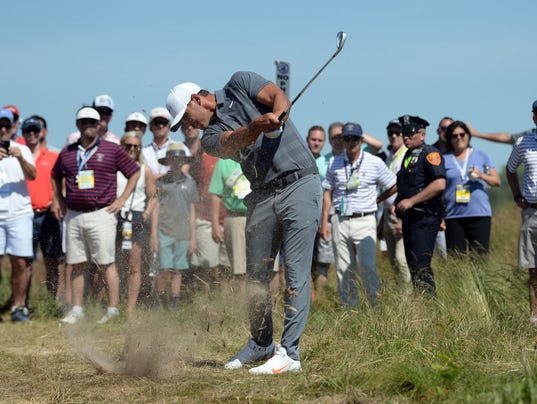
USAToday published an editorial (from which the picture got here) that wonders whether Shinnecock has grow to be obsolete as a US Open direction. I trust that is a wrong view to start with.
The actual question is whether the USGA's idea of a US Open setup is out of date. And that, I trust simply as strongly, may be very in all likelihood.
My Sunday rant took the USGA to challenge for ignoring the "architect's purpose" for the manner the route must play -- specially, the speed at which classically contoured veggies should be performed. (If you read that publish early on, I introduced an additional paragraph early Sunday because I realized there have been a couple of things the USGA does that I don't have a hassle with, however I failed to point out them so I desired that to be clean.) I contend that in case you need to project the professionals, you do not burn the vegetables out and lead them to impossibly speedy. Rather, you make them a touch smaller and nonetheless hold them playable.
You see, the USGA's idea of "shielding par" seems nonsensical to me. And I provide Sunday's setup as proof.
A total of 67 players made the cut at Shinnecock. And after the debacle on Saturday, the USGA on Sunday made what most of us -- me included -- consider an overcompensation. And let's be honest, they needed to. They owed Shinnecock an apology for swearing up and down that they wouldn't make the same mistakes they made in 2004... and then they made worse ones on Saturday.
But after looking at how the path performed within the very last round, I surely don't understand WHY the USGA made the selections they did on Saturday inside the first region!
Let's have a look at the facts.
Of the sixty seven players to make the cut, Sunday?S admittedly smooth setup produced handiest 15 ratings underneath par, and most effective four better than -2. That's just over 22% of the sphere -- not even 1 / 4 of them broke par. If you want the exact breakdown, there was:
- one 63 (-7)
- one 65 (-5)
- one 66 (-4)
- one 67 (-3)
- three 68s (-2)
- eight 69s (-1)
And the sphere average was seventy two.Three strokes. Correct me if I'm wrong, but it is a mean of two over par for the complete field.
Sunday's setup concerned slowing the greens down to what they ought to had been all alongside, softening the greens a piece extra than necessary, and moving kind of half of the flags to the middle of their respective veggies. They made the route MUCH less difficult than maximum of us believe became vital, but much less than a quarter of the sphere beat par and the sector common was more than two strokes over par.
If that setup didn't test the players, and if if was too easy in the USGA's eyes to "protect par," then what the hell do they think their job is???
If they agree with their process is to save you ANY participant from breaking par, then they aren't interested by checking out the players' abilties. I repeat what I said Sunday -- they can get the ones type of consequences with the aid of using a cow pasture, however the consequences might not be what I'd call 'golf.'
Some will debate that it's the fault of the equipment but, from a historical standpoint, the US Open is typically won with a score close to -8. If there's a need to blame something for good scores, then blame it on the influx of athletes to our game. And since that's presumably what everybody wanted, in order to legitimize our game as a sport in the general public's eyes, then making the course artificially harder to keep them from doing what they do seems a bit myopic to me. It's the equivalent of the NBA raising the baskets an extra five to ten feet during the Playoffs. It defies common sense.
If the debacle at Shinnecock -- and the consequent 'clean' setup on Sunday -- has proven something, it is that the USGA needs to reexamine its know-how of how to 'test players' and 'defend par.' Because as some distance as I can see, when you have a legendary path like Shinnecock, you do not actually need to push the course to the edge to create a test that protects par.
You just want a few recognize for the course and a little commonplace experience.


0 comments